


How to Choose the Right Bike Rack for Your Car
February 10, 2022
With so much variety out there, figuring out how to choose a bike rack for your car can be a real challenge. There's a lot to consider! In this guide, we cover what to look for when choosing a bike rack, types of car racks for transporting your bikes, the pros and cons of each type, and some important driving tips for once your bike rack is installed. Before you know it, you'll be hitting the road and traversing trails with the right bike rack for your Nissan and your needs.
What to Consider When Choosing a Bike Rack
Bike racks are a useful addition to any vehicle. Not only do they help you save space inside the car, having a rack means you won't have to take your bike apart to fit it in the trunk. Yet not every bike rack is going to be the right fit for your car. What's best for you will depend on key factors such as available mounting points on your vehicle, the number of bikes you need to transport, and budget. Consider the following factors to help narrow your decision.
- Available mounting points (Does your car have a utility rack on the roof? A trailer hitch? Neither?)
- Number of bikes needing transport (racks can hold 1 to 4 bikes)
- Types of bikes needing transport (mountain bikes are generally heavier than road bikes, and every rack has a specific weight limit)
- How easy the bike rack is to set up and use (some are easier than others)
- How often the bike rack will be used (some racks are removable, others are semi-permanent)
- Other sports equipment that may need transporting (certain racks can carry more than just bikes)
- Budget (prices can range from around a hundred dollars to over a thousand)
Types of Bike Racks
Roof Mount
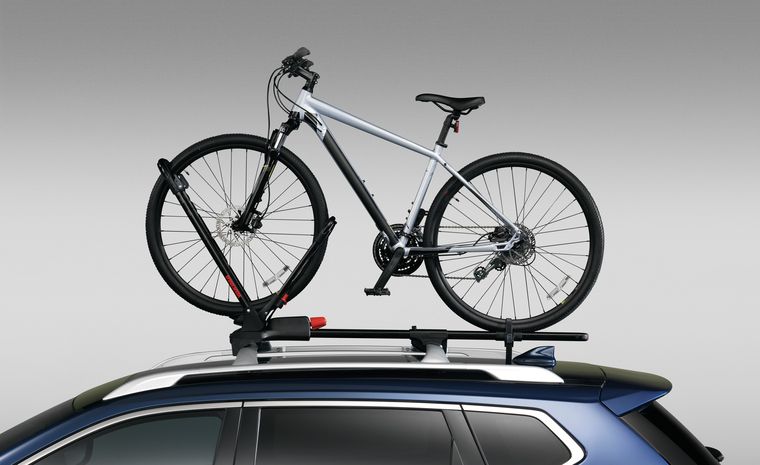
Most conventional roof-mounted bike racks must be attached to an existing roof rack system on top of your vehicle. In most cases, this means the factory-built crossbars that come with many SUVs and hatchbacks. Your Nissan's year, make, and model will determine what type of roof rack fits and whether you need to get a utility rack to mount it on.
Roof-mounted bike racks typically hold up to two bikes. Depending on the size of your vehicle, however, a roof mount may be able to hold as many as three or four bikes.
Conventional roof mounts come in two different variations: "fork mount" and "upright." A fork-mounted bike rack requires the front bicycle wheel to be removed so the bike can be secured via the two-pronged bike fork that holds the wheel. Removing the front wheel lowers the bike and increases stability, but many see the extra steps of removing, storing, and reattaching it as a big downside to fork mounts. In contrast, an upright roof mount conveniently keeps the front wheel on the bike. The trade-off is that the bike stands taller, is heavier to lift, and may be less stable.
The best thing about roof-mounted bike carriers is their versatility. On Nissan cross bars, a kayak rack can easily be swapped with a bike rack. Also, installing a roof mount means you maintain access to the trunk of your Nissan.
On the other hand, some people may find roof-mounted bike carriers moderately challenging to use. Lifting bikes overhead and securing them to the top of a car can be challenging for shorter people and those with less upper body strength. Second, the increased air resistance from bikes on the roof significantly lowers fuel efficiency at high speeds. Lastly, the increased height on top of your car means you must be extra vigilant about low-hanging structures and garage ceilings ‐ or risk severe damage to your bicycles and car.
Pros:
- Versatility in gear-hauling
- Very secure (especially fork mounts)
- Trunk access
- Rear-window not obstructed
Cons:
- Requires utility rack and crossbars
- May be challenging to load bikes on roof
- Lowers fuel economy
- Increased height risks damage to bikes and vehicle
Hitch Mount
If your Nissan has a trailer hitch (like the Nissan Frontier or Rogue), a hitch-mounted bike carrier may be right for you. A hitch rack is designed to be a semi-permanent fixture that slides into the 1¼-inch or 2-inch receiver tube at the back of your car. While hitch mounts tend to be more expensive than other types of racks, they are widely considered among the most convenient and easy to use bike rack options. Simply slide and lock the rack into your hitch receiver and your bikes are ready for easy loading.
Hitch-mounted carriers generally work in two ways: securing the wheels from the bottom with a horizontal undercarriage or using a vertical bar to hang bikes from their top tubes. Racks with a 1¼-inch hitch attachment hold up to two bikes, whereas 2-inch hitch attachments (found on larger vehicles) can sometimes hold as many as five bikes. Some hitch racks even come with a built-in hinge that allows the rack to swing away from the vehicle so you can access the trunk ‐ though these are often more expensive.
Note that hitch racks add length to the back of your car, so be extra cautious when parking and reversing your vehicle.
Pros:
- Easy installation and use
- Very secure
- No need to lift bikes overhead or remove front wheels
- High bike capacity on 2-inch hitch models
Cons:
- Requires trailer hitch
- Tend to be more expensive
- Adds length to vehicle
- May or may not allow hatch access
- May obstruct view through rear window and/or backup camera
Truck Bed Racks & Tailgate Pads
If you're looking to transport bikes in your pickup truck and have open truck bed space, consider a truck bed bike rack or a tailgate pad. With a truck bed rack, you can securely store upwards of four bikes in your truck's back.
For a simpler alternative, try a tailgate pad. Tailgate pads are popular because they allow drivers to safely haul as many as seven bikes on some models while protecting the paint on the truck. Simply drape the pad over both sides of the tailgate and use the straps to secure it in place. Once the bikes are loaded in, secure them to the pad with straps that wrap around each bike's down tube.
Pros:
- Safely haul many bikes
- Simple and easy to use
- Protect paint job
Cons:
- Requires truck with open bed space
- Not as secure as roof or hitch mounts
Safety Tips for Driving with a Bike Rack
With the addition of a bike rack to your Nissan, you may need to adjust the way you drive. Here are a few things to be mindful of before you head off for the trails.
- Always follow installation instructions carefully and secure straps and moving bike parts before driving.
- With roof racks, beware of height restrictions on roads, drive-throughs, and garages, so you don't accidentally wreck your bikes and damage your car. Consider putting a visible reminder of your roof-mounted bikes on your dashboard, especially before long road trips.
- With hitch racks, be mindful of the extra space needed for parking and reversing to avoid accidentally bumping other cars.
- As trunk mounts are most susceptible to theft, be conscious of where you are parking your vehicle and/or leaving your bikes unattended.
- Secure moving bike parts, such as steering columns and pedals, to protect bikes from damaging each other or scratching the paint on your car.
- Ensure bikes are loaded at an appropriate height to avoid contact with the road at steep angles and exposure to the exhaust pipe, which may melt rubber tires over time.
Ready to find the right bike rack for your vehicle? Find bike racks made-to-fit your Nissan model online.
Affiliated Yakima Forklift Rack Affiliated Yakima Holdup 2 Rack Shop All Nissan Accessories