


Step-by-Step Guide to Towing a Travel Trailer for the First Time
August 7, 2020
Towing a travel trailer for the first time? There's a lot to familiarize yourself with when it comes to towing. Following safety guidelines, getting the proper equipment, outfitting towing accessories, and a bit of practice are all important to making your first trailer outing a rewarding experience. In this guide, we cover what you need to pull a travel trailer, how to drive with a trailer, and some must-read trailer towing tips to be mindful of during your travel trailer adventure.
While you're here, don't forget to review our 2020 Nissan Towing Guide for the most up-to-date and complete information on how to safely tow a travel trailer for the first time.
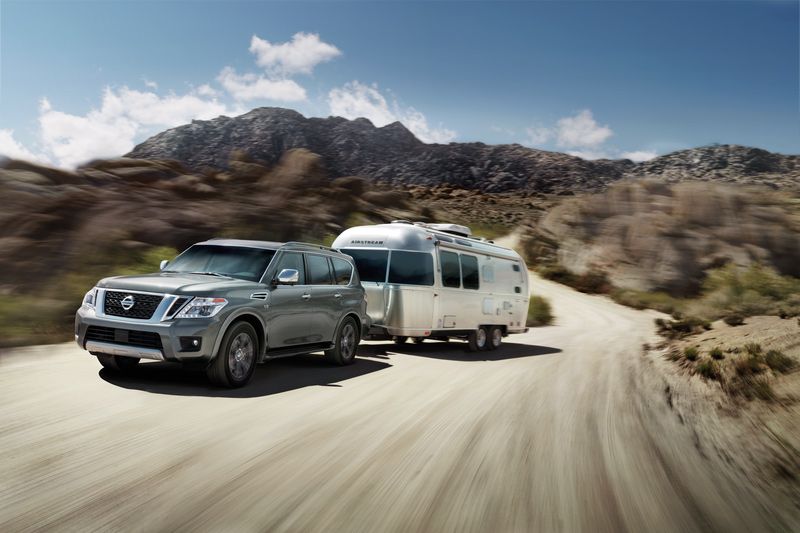
What Do You Need to Pull a Travel Trailer?
In order to pull a travel trailer, you need two essential things: knowledge of your vehicle's towing capacity and the proper towing equipment.
Towing Capacity
Your tow-enabled Nissan ‐ whether SUV, crossover, or truck ‐ is only capable of safely towing objects within a certain weight limit. A Nissan Rogue, for example, wouldn't be able to tow an 8,000-pound, 30-foot camper ‐ but a TITAN or TITAN XD could handle that load with the right hitch and mount system.*
There are four different weights to consider when towing: Gross Vehicle Weight, Gross Axle Weight, Gross Combined Weight, and Trailer Tongue Weight. Each of these measurements has a weight rating, such as Gross Vehicle Weight Rating (GVWR), that is specified in your owner's manual or on the Federal Motor Vehicle Safety Standard certification label located inside the driver's-side door area.
To ensure your vehicle does not exceed its weight ratings for towing, bring it to a public scale ‐ such as those at truck stops or some moving companies ‐ and follow the weighing instructions for each of the four measurements as specified in the 2020 Nissan Towing Guide.
Equipment
When it comes to the proper towing equipment, there are several items you must have to safely and legally tow a travel trailer. These include a hitch, ball mount, hitch ball, trailer tongue, safety chains, wiring harness, and brake system (typically required for vehicles towing more than 1,500 lbs). Below are definitions of various parts you'll find in different towing systems.
- Bumper Hitch: A reinforced bumper designed to accommodate a hitch ball.
- Receiver Hitch: A frame- or structure-mounted hitch with a receiver that allows removal of the ball mount.
- 5th Wheel or Gooseneck Hitch: Located just forward of the rear axle centerline in the bed of a truck, this hitch uses a king pin to serve as the pivot point for heavy-duty trailer towing. (Titan XD only.)
- Weight-Distribution Hitch System: Type of hitch system that helps distribute the trailer tongue weight to all the axles of the tow vehicle trailer tires. Strongly recommended when towing trailers with a Maximum Trailer Weight greater than 5,000 lbs.
- Ball Mount: A bar that holds the hitch ball and is inserted into the hitch receiver. Also commonly called a drawbar.
- Hitch Ball: A ball that connects the trailer to the tow vehicle hitch that provides the means by which the trailer pivots during cornering. Available in a number of sizes and weight capacities, it must correspond to the trailer coupler size, and have a sufficient capacity rating for the trailer being pulled. Only use the size hitch ball that is an exact match to the size of the trailer coupler. Check the trailer coupler for what size ball is required.
- Trailer Tongue: The part of the trailer that extends forward to meet the tow vehicle, and carries the coupler assembly.
- Safety Chains: Provides an emergency connection between the tow vehicle and the trailer, should the trailer become disengaged for any reason.
- Wiring Harness: Provides an electrical connection linking the tow vehicle's electrical system to the trailer's system for taillights, brake lights, and turn signals, as well as brake systems and breakaway switch.
- Electric Trailer Brakes: When the brakes on a tow vehicle are applied, an electric current is sent to an actuator, which applies the trailer's brakes.
- Surge Brakes: Hydraulic-type braking system activated by inertia. As the tow vehicle begins to brake, the trailer pushes against the hitch ball, consequently activating the trailer brakes.
No matter how often you haul your trailer, we offer a full range of Genuine Nissan Parts and Accessories to help you tow confidently. Find extendable side mirrors, brand new hitch receivers, and more, all made to fit your exact Nissan model.
How to Drive with a Trailer
Once you know your vehicle is properly rated for the tow load and have the appropriate size of hitch and ball installed, you're ready to attach the trailer and hit the road! Follow these steps to get started.
1. Attach Trailer to Tow Vehicle
Using a tongue jack, raise the trailer so you can align the tow vehicle's hitch ball underneath the trailer tongue. When the hitch lock is aligned with the ball, lower the trailer tongue onto the ball and lock it in. Then, cross the safety chains in a loose "X" formation under the trailer tongue and attach them to the hitch or vehicle frame. Leave enough slack in the chains so they don't bind when cornering, but not so much that they drag on the ground. Finally, inspect the coupler to be sure it is correctly attached to the ball when it is locked in. If using a weight distributing hitch, refer to the instructions for the model of the hitch you are using.
2. Connect the Wiring Harness
The wiring harness provides electricity to your trailer's lights and braking system, if equipped. Typically, the wiring harness uses a simple color-coded system to ensure the connectors are attached in the right spots on your tow vehicle. Once the harness is connected, check that the brake lights and turn signals are working properly. Consider using a small amount of dielectric grease on the contact points to prevent corrosion over time.
There are both 4-way and 7-way trailer connectors. A 4-way connector will include only the basic lighting functions, while a 7-way connector has lighting functions but also a 12-volt circuit, circuit for electric trailer brakes, and an auxiliary or a reverse light power circuit.
Did you know? The 2020 TITAN actually has a Trailer Light Check system that allows one-person hook-up operation ‐ including checking turn signals, brake lights, and running/clearance lights.
3. Check Tongue Weight
Trailer tongue weight should be 10-15% the total weight of the trailer. Any more than that and you have too much weight on the rear of your tow vehicle. Less than that and the trailer becomes unstable. Various methods for measuring and adjusting tongue weight can be found in the 2020 Nissan Towing Guide.
4. Final Inspection
Once everything is hooked up and the tow weight is properly distributed, it's time to run through a final check of your rig. Assess hitch height to ensure the trailer floor and tongue are as level as possible. This helps prevent over-angling, bottoming-out, and unsafe tongue load. Check tire pressure on the tow vehicle and trailer and make sure they are up to recommended standards.
Double check the lighting system, safety chains, hitch lock, and that any cargo in the trailer is safely secured. Finally, inspect your tow vehicle's engine and transmission oil levels, coolant, and any other part that may be put under strain during towing. Make a checklist to refer to before every tow.
5. Drive with Increased Awareness
When you're sure everything is ready to go, hit the road ‐ but do so with extra caution and awareness. You will immediately notice the dramatic change in your tow vehicle's handling and performance, and should take extra care when on the road with other drivers.
Be aware of your increased rig size when turning, merging, and changing lanes. Accelerate slowly and brake gradually with plenty of stopping distance. Take note of the lower fuel economy while towing and be prepared for greater wear and tear on your vehicle.
6. Stop to Check Trailer Often
Even though you checked and double checked that your trailer was properly secured to your tow vehicle before leaving, it's best to stop re-inspect it after the first 20 minutes of driving and every couple of hours thereafter.
Bumps and vibrations on the road can loosen even the tightest hitch locks ‐ so we strongly recommend you stop to inspect your trailer connection, hitch, and cargo often. At a minimum, every time you stop for gas.
Trailer Towing Tips
The first time towing a travel trailer can be an intimidating experience, but with a little extra care and practice, you'll get the hang of it in no time. When you first get behind the wheel, you'll notice a few things right away: your vehicle will not accelerate as quickly, it will not stop as quickly when braking, and any abrupt movements may unbalance the load and decrease rig stability. Here are a few tips to handle this change in performance.
Increase Following Distance & Be Brake Aware
The increased weight of your combined tow vehicle and trailer means it requires a greater distance to fully stop. Pace yourself on the road and try to keep several vehicle lengths between yourself and the car in front of you. For every 10 mph of speed, allow one tow vehicle and trailer length of room in front of you and the next car's rear bumper. When it comes to braking, gradually but firmly apply more pressure on the pedal over your increased stopping distance. Do not slam on the brakes.
Pass Carefully
With decreased acceleration and a longer rig, it will take longer to pass other vehicles on the road. Give yourself plenty of time and space when changing lanes, passing, or merging. With the longer overall length, you will need to be farther ahead of the vehicle you are overtaking before you can safely return to your lane.
Corner More Slowly
Avoid turning too fast so the trailer doesn't "whip" out from behind your vehicle. Instead, begin braking sooner than usual and in a straight line if possible. When you reach the corner, turn slowly and smoothly into it at a wide angle to ensure the trailer clears the inside of the turn.
Back Up with Caution
Backing up with a trailer is one of the most difficult maneuvers for first-time trailer drivers. The key to doing it right is remembering that the trailer goes in the same direction your steering wheel turns. Back up with your wheel turned to the left, the trailer will move left. Keep the wheel turned right and the trailer will move right.
Be sure to back up slowly and in small increments to adjust as needed. Have a passenger jump out of the vehicle and act as a "spotter" to guide your movements.
Park Smart
Once you've parked your trailer in a tight spot, it can be a nightmare to try and maneuver out of it. With that in mind, look for parking areas where you'll have ample room to get in and out with your rig. Once parked, always block the wheels on both the tow vehicle and trailer. Avoid parking on slopes if possible. Also, plan your exit. Consider how other people may park around you before you return. Will you be able to get out of your parking spot safely?
Maintain Your Vehicle with Diligence
With the added strain towing can put on your vehicle, it will likely need maintenance and repairs more often. Be aware of fluid levels like engine and transmission oil as well as coolant and brake fluid, and keep an eye on tires, brakes, and belts for extra wear. Don't push your vehicle past its limits, and get it serviced often if you plan on towing for extended periods of time.
Practice First
All of this information is a lot to take in for first-time trailer towers. The best way to really understand what it all means and how to apply it is to get out there and practice. Take your tow vehicle and travel trailer to an empty lot with plenty of room to maneuver. Get familiar with the size and feel of your rig, then practice turns, braking, backing up, and any other maneuvers until you feel confident in your ability to safely tow your trailer. Remember, practice makes perfect!
Everything You Need to Tow with Confidence
Now that you have the know-how, it's time to hitch up your travel trailer! Make sure your Nissan is equipped with a compatible tow hitch receiver by shopping for Nissan towing accessories made for your exact make and model.